Introduction
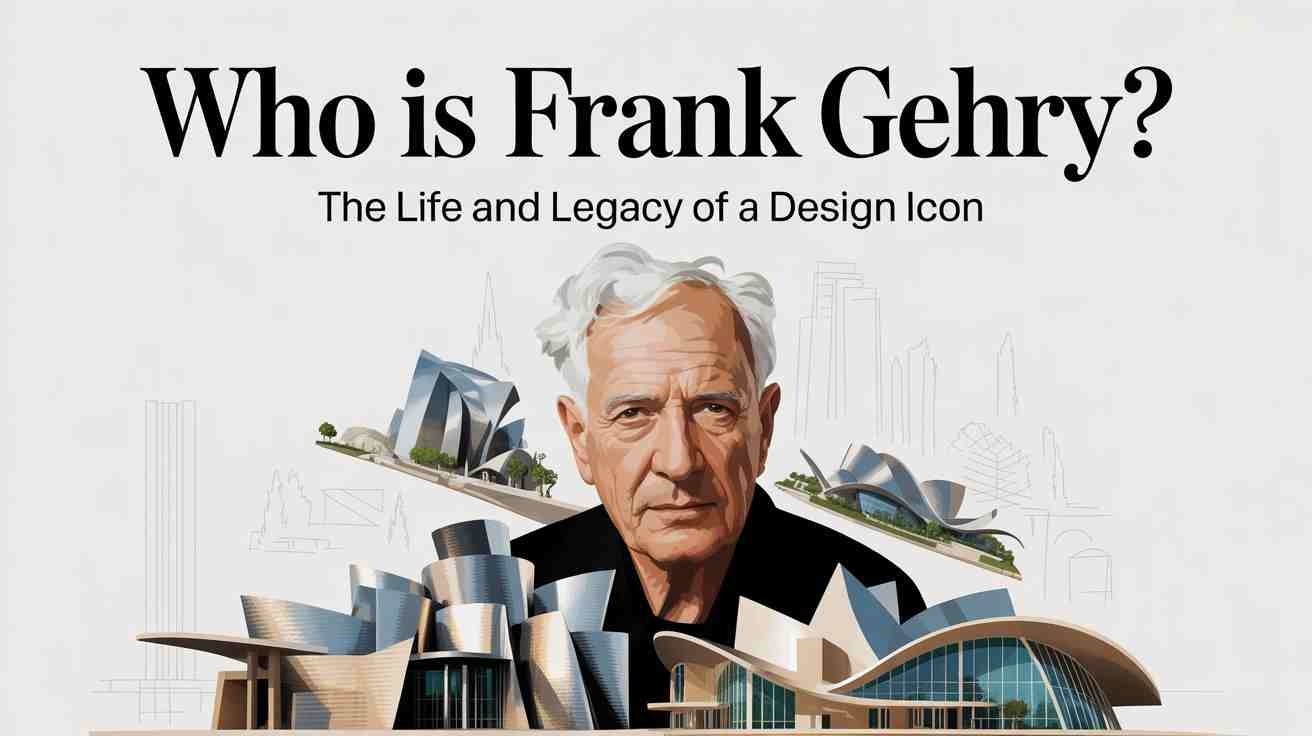
Frank Gehry, born Frank Owen Goldberg on February 28, 1929, is a renowned Canadian and American architect. He is celebrated for his bold and innovative approach to architecture. His unique style often incorporates sculptural and undulating exteriors, making his works instantly recognizable. Some of his iconic creations include the Guggenheim Museum Bilbao, the Walt Disney Concert Hall in Los Angeles, and the Louis Vuitton Foundation in Paris. Gehry’s genius lies in his ability to transform everyday materials, such as titanium and stainless steel, into dynamic structures that defy convention.
Throughout his career, Gehry has received the highest honors, including the prestigious Pritzker Architecture Prize in 1989. He has also been awarded the National Medal of Arts and the Presidential Medal of Freedom. His work has earned him a place among the most influential architects of our time.
Gehry’s influence extends beyond architecture to include designs in furniture, jewelry, and even liquor bottles. With his unique blend of sculptural architecture and groundbreaking design, Gehry’s impact on contemporary architecture is undeniable. His legacy continues to inspire new generations of designers and architects.
Early Life of Frank Gehry
Frank Gehry, born Frank Owen Goldberg on February 28, 1929, in Toronto, grew up in a creative family. His grandmother, Leah Caplan, played a significant role in his early life. She helped him build futuristic cities from wood scraps gathered from her hardware store. These Saturday mornings spent drawing and dreaming laid the foundation for Gehry’s passion for design. His mother introduced him to the world of art, inspiring him to pursue architecture. However, antisemitism was a constant challenge in his life.
In 1954, Gehry changed his surname from Goldberg to Gehry, influenced by his wife, Anita. Growing up in Timmins, Ontario, and later in Toronto, Gehry was surrounded by utilitarian materials like chain-link fencing, corrugated steel, and unpainted plywood. These materials later became signature elements of his architectural style. His upbringing, filled with both encouragement and adversity, shaped him into one of the most influential architects.
The Early Education of Frank Gehry
Frank Gehry’s architectural journey began in an unexpected way. He worked as a delivery truck driver in California while attending City College in Los Angeles. Gehry explored various interests, including radio announcing and chemical engineering. However, his love for art, museums, and paintings led him to architecture. His mother played a key role in shaping his passion, taking him to concerts and museums. Driven by this passion, Gehry enrolled in architecture courses at the University of Southern California.
There, he studied under renowned architect William Pereira. After graduating in 1954, he moved his family to Cambridge, Massachusetts, to study city planning at Harvard University. Despite his progressive views on socially responsible architecture, Gehry grew disillusioned by the lack of support for his ideas.
His frustration grew when he learned about a secret architectural project for Cuban dictator Fulgencio Batista. This left him feeling betrayed and disappointed with the architecture community. This experience deeply affected Gehry, fueling his disillusionment with conventional design.
Gehry’s Early Career and First Architectural Projects
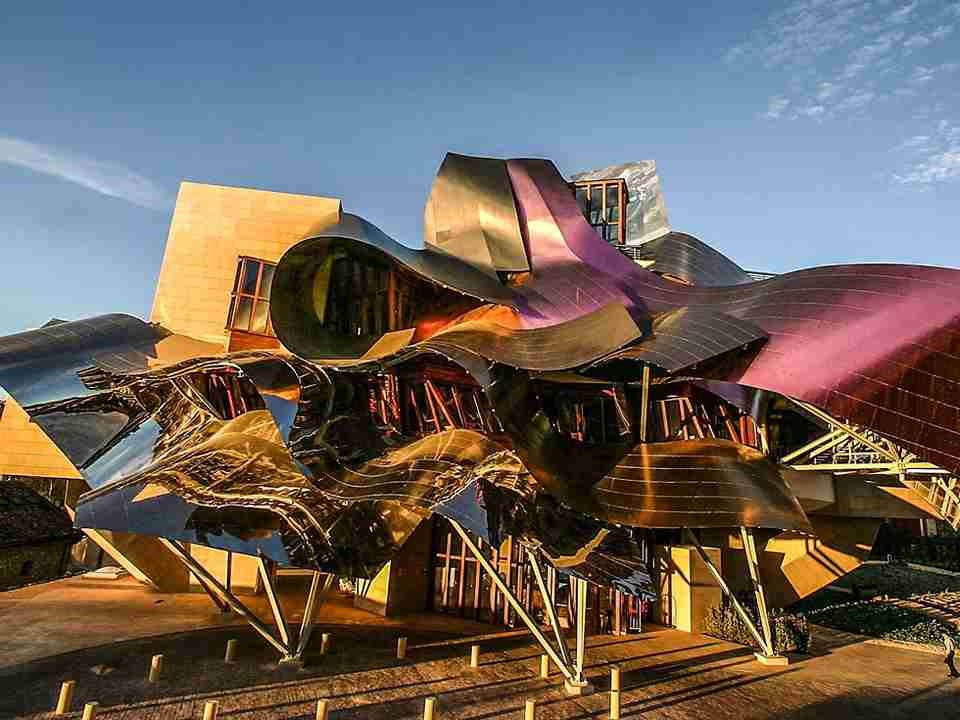
Frank Gehry’s architectural journey began in 1957, when he was just 28. He designed his first private residence for Melvin David in Idyllwild, California. Gehry collaborated with his friend Greg Walsh on the project, featuring bold elements like exposed ceiling beams and beams extending from the exterior sides. The 2,000 sq ft residence included vertical-grain Douglas fir detail, marking the start of his signature style. Over the years, Gehry designed innovative commercial structures like Santa Monica Place in 1980 and the Norton House in Venice, Los Angeles (1984).
During this time, he worked at Victor Gruen Associates and explored urban planning, which shaped his unique design approach. In 1962, Gehry established his own practice, which became Frank Gehry and Associates in 1967 and later Gehry Partners in 2001. His time in Paris and early influences, like Shōsōin in Nara, Japan, deeply impacted his work. Gehry’s use of raw materials and unconventional forms became central to his revolutionary architectural career.
Gehry’s Iconic Designs and Global Recognition in the ’80s and ’90s
In the 1980s and 1990s, Frank Gehry emerged as one of the most innovative architects, known for his bold designs and experimental approach. A standout project from this period was the renovation of his own Santa Monica residence (built in 1920), where he wrapped a metallic exterior around the original structure, leaving many of the original details visible. This work demonstrated his unique ability to blend the old with the new. In 1989, Gehry’s groundbreaking style earned him the Pritzker Architecture Prize, with the jury praising his willingness to experiment, much like Picasso in the art world.
Throughout this time, Gehry designed iconic buildings, such as the Cabrillo Marine Aquarium (1981), the California Aerospace Museum (1984), and the Chiat/Day Building (1991), featuring massive binocular sculptures in collaboration with Claes Oldenburg. His global influence grew with commissions like the Cinémathèque Française in Paris (1994) and the striking Dancing House in Prague (1996).
Gehry’s designs were celebrated for their juxtaposed collages of materials and spaces, creating environments that were as much about performance and experience as they were about architecture. Each building invited users to explore both the visible and hidden aspects of its design.
Gehry’s Landmark Designs and Prestigious Commissions
Frank Gehry became a household name in architecture with groundbreaking designs that reshaped skylines worldwide. His work on the Guggenheim Museum Bilbao (1997) in Bilbao, Spain, was widely celebrated as a 20th-century masterpiece. Philip Johnson famously called it “the greatest building of our time.” Gehry’s Walt Disney Concert Hall (2003) in Los Angeles is another iconic piece, helping revitalize the downtown area with its bold, curvaceous design.
Gehry also brought his visionary touch to places like Chicago’s Jay Pritzker Pavilion (2004) and Miami Beach’s New World Center (2011). He continued pushing boundaries with academic buildings such as MIT’s Stata Center (2004) and Princeton’s Peter B. Lewis Library (2008).
Gehry’s Beekman Tower (2011), his first skyscraper in New York City, became a standout residential building. Whether designing concert halls, museums, or commercial buildings, Gehry’s works are known for their striking aesthetic appeal and have had a profound economic impact on cities.
Gehry’s Key Works, Global Projects, and Unfinished Designs
Frank Gehry has transformed architecture with his bold and innovative designs. His Beekman Tower (2011) in New York City (8 Spruce) and the Stata Center (2004) at MIT show his ability to blend form and function. Gehry’s Museum of Pop Culture (2000) in Seattle and the IAC Building (2007) in New York City have played key roles in urban revitalization. Gehry’s global acclaim grew with iconic works like the Guggenheim Museum Abu Dhabi and the Dr.
The Chau Chak Wing Building at the University of Technology Sydney (2014), praised for its stunning sweeping lines. He also designed the Forma skyscraper in Toronto and worked on projects like the Philadelphia Art Museum renovation. Some of Gehry’s ambitious designs, like the Corcoran Art Gallery expansion and the World Trade Center Performing Arts Center, didn’t come to fruition.
However, his work in residential buildings, concert halls, and commercial buildings continues to shape cities, including the Grand Avenue Project in Los Angeles and the National Dwight D. Eisenhower Memorial (2014).
Gehry’s Key Projects and Reflections in the 2010s+
In 2014, Frank Gehry unveiled two long-awaited museums: Biomuseo in Panama City, a biodiversity museum, and the Fondation Louis Vuitton in Paris, a modern art museum. Both projects received positive reviews, showcasing Gehry’s continued impact on the world of architecture. In the same year, Gehry was commissioned by River LA (formerly Los Angeles River Revitalization Corporation) to create a new plan for the river’s revitalization. Another notable moment occurred when Gehry’s 8 Spruce Street (formerly Beekman Tower) in New York City was built 1 foot taller than the nearby Trump Building, leading to a famous exchange. In the 2020s, Gehry designed the Dwight D.
Eisenhower Memorial in Washington, DC, and the LUMA Arles museum in France, cementing his legacy. He also made significant progress on the Grand Avenue Project in Los Angeles, which includes a concert hall for the Youth Orchestra Los Angeles and an office building for Warner Bros. Despite some political tension, with French president François Hollande offering him a move to France if Donald Trump became president, Gehry’s focus remained on shaping cities with his museums, residential buildings, and concert halls.
The Architectural Style of Frank Gehry
Frank Gehry has built a reputation for his groundbreaking and experimental designs that defy categorisation. While his work is deeply rooted in modernism, he sought to move away from traditional stylistic tropes, drawing inspiration from movements like the California funk art movement of the 1960s and 1970s. Gehry’s designs often incorporate unconventional materials, such as chain-link fencing, corrugated metal siding, and found objects like clay and other nontraditional media.
His creations are not just sculpturally exciting but also designed to offer good experiences, challenging the usual boundaries of architectural form. Although some of his works may appear unfinished or crude, they are deeply influenced by European art history and his classical training.
A 1988 retrospective at the Whitney Museum revealed Gehry’s mastery of both modern experimentation and classical artistry. Despite facing pressure to do more with less, Gehry’s ability to blend bold design with historical influences has made his style both timeless and relevant.
Exploring Gehry’s Design Philosophy
Frank Gehry has always seen architecture as a form of sculpture, stating, “a three-dimensional object, therefore sculpture.” This belief reflects his unique approach, blending both artistic and architectural disciplines. Gehry’s Jewish heritage and immigrant experience deeply influence his reinterpretation of traditional forms. His work often conveys a multicultural experience and a strong focus on creativity, along with a critique of consumerism.
Gehry challenges conventional designs by deconstructing traditional forms, drawing inspiration from Viktor Shklovsky’s idea of “laying bare the device.” This leads to architecture that embraces flow and defamiliarization, making his designs stand out. By breaking free from luxury expectations, Gehry’s buildings are sculpturally exciting and invite new ways of thinking about space and structure.
Education and Design Career
Education and Academia
Frank Gehry began his academic journey at the University of Southern California (USC) in 2011, where he served as the Judge Widney Professor. Continuing his work at his alma mater, he also taught at renowned institutions such as Harvard University, University of California at Los Angeles, Columbia University, University of Toronto, Federal Institute of Technology in Zürich, and Yale University.
Though often labeled a “starchitect,” Gehry dismissed this term, emphasizing that he was simply an architect. In 2017, Gehry shared his expertise with a wider audience through a new architecture course on MasterClass, offering students worldwide access to his innovative approach to design.
Creative Exhibition Design
Frank Gehry’s work in exhibition design has changed how we interact with art. In 1965, Gehry designed the Art Treasures of Japan exhibition at the Los Angeles County Museum of Art (LACMA). He blended modern aesthetics with traditional elements, creating a unique viewing experience. His design style was evident in exhibitions like the Billy Al Bengston Retrospective and Treasures of Tutankhamen.
Gehry transformed spaces with installations and photography, creating immersive environments for visitors. In 2014, Gehry collaborated with curator Stephanie Barron on The Art of the Motorcycle exhibition. This collaboration cemented his influence on museum design. Gehry’s ability to merge architecture and art lets visitors experience exhibitions in an entirely new way. His work has shaped the future of museum and gallery experiences worldwide.
Innovative Stage Design
Frank Gehry’s stage design transformed how we experience music and performance. His creative touch shaped iconic venues like the Walt Disney Concert Hall in Los Angeles. Gehry reimagined the classical concert hall with bold, angled structures that amplify sound and energy during performances. He collaborated with Pierre Boulez and the Los Angeles Philharmonic, creating spaces where music and architecture blend seamlessly. His design of the Fisher Center at Bard College shows his skill in crafting environments for opera and dance.
One standout contribution is the chain-link backdrop in Don Giovanni at the Brooklyn Academy of Music, which adds a raw, dynamic quality to the set. Gehry’s influence extends beyond the U.S. to venues like the Museum of Contemporary Art in Chicago. His designs in Paris and New York City have redefined how theatre and opera productions interact with their surroundings. This offers a more immersive experience for both artists and audiences alike.
Additional Designs
Frank Gehry’s creativity goes beyond architecture; he has also designed furniture, sculptures, and household items, like a glass bottle for Wyborowa Vodka. His first furniture line, Easy Edges, produced between 1969 and 1973, was a groundbreaking cardboard collection. In 1992, he launched his Bentwood Furniture line, with pieces named after ice hockey terms, blending unique design inspirations.
His time in the U.S. Army in 1954 sparked his journey into furniture design, where he created furniture for enlisted soldiers. Gehry’s fascination with fish was inspired by Greek temples and life’s ancient history, not by accident.
He referenced Greek temples and the evolution of life over three hundred million years, linking fish with ancient history. His designs for brands like Tiffany & Co., Knoll, and Heller Furniture showcase his ability to mix nature, history, and art in everyday objects.
From Fish Lamps to Luxury Designs
Frank Gehry’s creative genius spans many fields, from the Fish Lamps designed between 1984 and 1986. These lamps used ColorCore plastic laminate shards and became a defining piece of his work. He created iconic sculptures, like the Fish Sculpture in Barcelona (1989–92) and the Standing Glass Fish in the Minneapolis Sculpture Garden (1986). Gehry also worked on luxury designs, collaborating with Tiffany & Co. on collections like Orchid, Fish, and Torque.
His furniture designs include the “Superlight” chair with Emeco, and he designed the World Cup of Hockey trophy in 2004, later redesigning it for the 2016 tournament. In 2015, Gehry designed his first-ever yacht, and in 2020, he created a limited edition bottle for Hennessy cognac. Gehry’s unique blend of innovation continues to influence fashion, luxury, and design, leaving lasting marks across industries.
Software Engineering
Frank Gehry’s influence reaches beyond architecture, extending into software engineering. In 2002, he launched Gehry Technologies, which later partnered with Dassault Systèmes in 2005. Together, they developed groundbreaking tools like Digital Project software and GTeam software. These tools introduced 3D modelling and project management capabilities, helping Gehry bring his complex designs to life—often under budget.
An example is the Guggenheim Museum Bilbao, which finished $3M under the original $100M budget, thanks to this software. In 2014, Trimble Navigation acquired Gehry Technologies, reinforcing the role of software in architecture, engineering, and construction (AEC), as well as manufacturing. Gehry’s pioneering use of software continues to influence modern architectural design today.
Read More: Rebecca Heinrich Age & Career: Everything You Need to Know
Frank Gehry’s Personal Life and Legacy
Frank Gehry, a renowned architect from Canada, became a U.S. citizen in 1951 after moving to Los Angeles. Growing up in Canada, he was an avid ice hockey fan and started his own hockey league, FOG. He continued playing until around the age of 80. In 2004, Gehry designed the World Cup of Hockey trophy, showcasing his creativity beyond architecture.
Gehry had two marriages: the first to Anita Snyder in 1952, ending in divorce in 1966, and the second to Berta Aguilera in 1975.
Known for his fiery temper, he made headlines in 2014 when he flipped off a reporter during a press conference. He lived in Santa Monica, where he enjoyed sailing his fiberglass-hulled yacht, Foggy, and was an active member of the California Yacht Club in Marina Del Rey. Gehry passed away at the age of 96 in 2025 due to a respiratory condition, leaving behind his wife, Berta, and three children. His family and architectural legacy were incredibly important to him, making him a celebrated figure in design.
Frank Gehry’s Contributions to Philanthropy
In 2014, Frank Gehry co-founded Turnaround Arts: California, a 501(c)(3) nonprofit that brings arts programs to under-resourced schools across California. The nonprofit aims to provide all students, regardless of background, with creative opportunities. Gehry served as a board member and worked hands-on as a visiting artist, engaging directly with students.
He dedicated his design talents to several pro bono projects, including his work with the L.A. River Revitalization Corp. to develop the LA River Master Plan. In 2015, Gehry waived his design fee to help create a new space for the Children’s Institute in Watts. This organization supports families who have faced violence and poverty.
He also designed the Youth Orchestra Los Angeles (YOLA), offering free instruments, music training, and academic support to young people from disadvantaged neighborhoods. This incredible project, completed in 2021, shows Gehry’s belief in the arts as a transformative power in uplifting lives.
Frank Gehry: A Legacy of Innovation
Frank Gehry is celebrated as one of the most influential architects of the 20th century. He revolutionized American architecture and global urban landscapes with his bold and unique designs. Gehry’s innovative use of materials like plywood, corrugated steel, and chain-link fencing became his architectural trademark. His designs pushed the boundaries of traditional architecture and reshaped how we view spaces.
Notably, with the Bilbao effect, his design for the Guggenheim Museum transformed Bilbao and revitalized its economy. The New York Times described him as a “Titan of Architecture,” and his buildings became iconic worldwide.
His influence was so profound that The Guardian called him “the most recognizable American architect since Frank Lloyd Wright.” Mark Carney, the Prime Minister of Canada, stated that Gehry’s visionary designs continue to live on globally. His groundbreaking use of computer design in the 1990s marked a turning point in architectural history.
The Bilbao Effect: Gehry’s Transformative Influence
The Bilbao effect describes how Frank Gehry’s design for the Guggenheim Museum revolutionized Bilbao. It turned the city into a hub for innovative architecture, sparking economic renewal. Gehry’s striking use of dramatic curves, titanium panels, and a focus on fluidity transformed the cityscape. This transformation drove both cultural and economic growth in the city. In the first 12 months, the museum brought an estimated US$160 million to the Basque economy.
By 2014, over $3.5 billion had been added to the Basque economy. Gehry’s approach influenced large-scale architectural commissions, like the Walt Disney Concert Hall in Los Angeles. His success also included controversial projects like Daniel Libeskind’s expansion of the Denver Art Museum. The Bilbao effect proved that Gehry’s architecture could transform both a city’s skyline and its economy.
Frank Gehry in Popular Culture
Frank Gehry isn’t just an icon in architecture; he has made his mark in popular culture. In 2004, he voiced himself in an episode of the children’s TV show Arthur, helping design a treehouse. The episode was called “Castles in the Sky”. A year later, he appeared in The Simpsons episode “The Seven-Beer Snitch”, designing a concert hall for Springfield. Although he regretted the cameo, it poked fun at his architectural process, showing his influence on entertainment.
In 2006, filmmaker Sydney Pollack made the documentary Sketches of Frank Gehry, offering a positive portrait of the architect. Then, in 2009, the ice cream company Coolhaus, inspired by architecture, created the “Frank Gehry” sandwich. This ice cream combination had Strawberries & Cream gelato and snickerdoodle cookies, blending creativity and design in an unexpected way.
Frank Gehry: A Showcase of His Exhibitions
Frank Gehry’s architecture and design have always stood out in the art world. His first major exhibition in 1983 at the Leo Castelli Gallery set the stage for his global presence. Over the years, his work has been featured in museums like the Solomon R. Guggenheim Museum and the Philadelphia Art Museum. It has also traveled to prominent events like the Venice Biennale. Gehry’s sculptures, especially his fish sculptures, are more than art—they are installations that invite deep reflection.
Whether mounted at the Museum of Modern Art or in a curated show at the Gagosian Gallery, Gehry’s contributions to modern art and architectural performance are widely celebrated. His facade designs, like the Strada Novissima, displayed his innovative spirit and shaped how we view art events. Each exhibit brings Gehry’s bold vision to life, cementing his place as a pioneer in both architecture and art.
Recognition and Achievements
| Year | Award/Honor |
| 1974 | Fellow of the American Institute of Architects |
| 1977 | Arnold W. Brunner Prize in Architecture |
| 1986 | Distinguished Architect Award from the American Institute of Architects (Los Angeles Chapter) |
| 1987 | Fellow of the American Academy of Arts and Letters |
| 1988 | Elected into the National Academy of Design |
| 1989 | Pritzker Architecture Prize |
| 1992 | Praemium Imperiale |
| 1994 | The Dorothy and Lillian Gish Prize |
| 1994 | Thomas Jefferson Medal in Architecture |
| 1995 | American Academy of Achievement’s Golden Plate Award |
| 1995 | Chrysler Award of Innovation in Design |
| 1998 | National Medal of Arts |
| 1998 | Inaugural Austrian Frederick Kiesler Prize for Architecture and the Arts |
| 1998 | Gold Medal Award, Royal Architectural Institute of Canada |
| 1999 | AIA Gold Medal, American Institute of Architects |
| 2000 | Cooper–Hewitt National Design Award Lifetime Achievement |
| 2002 | Companion of the Order of Canada (CC) |
| 2004 | Woodrow Wilson Award for Public Service |
| 2006 | Inductee, California Hall of Fame |
| 2007 | Henry C. Turner Prize for Innovation in Construction Technology from the National Building Museum (on behalf of Gehry Partners and Gehry Technologies) |
| 2008 | Order of Charlemagne (Grand Cross, later returned), Andorra |
| 2012 | Twenty-five-Year Award, American Institute of Architects |
| 2014 | Prince of Asturias Award |
| 2014 | Commandeur of the Ordre National de la Légion d’honneur, France |
| 2015 | J. Paul Getty Medal |
| 2016 | Harvard Arts Medal |
| 2016 | Leonore and Walter Annenberg Award for Diplomacy through the Arts, Foundation for Arts and Preservation in Embassies |
| 2016 | Presidential Medal of Freedom |
| 2018 | Neutra Medal |
| 2019 | Inductee, Canada’s Walk of Fame |
| 2020 | Paez Medal of Art, New York City (VAEA) |
Frank Gehry earned a prestigious position in the College of Fellows of the American Institute of Architects (AIA) in 1974. He received numerous awards for his groundbreaking architecture over the years. Born in Canada, Gehry became a naturalized American citizen in 1951.
He regained his Canadian citizenship in 2002, taking the oath in Prime Minister Jean Chrétien’s office. Gehry also contributed his expertise by serving on the steering committee of the Aga Khan Award for Architecture. His work has left a lasting impact on global architecture and design.
Distinguished Degrees
| Year | Institution |
| 1987 | California Institute of the Arts |
| 1987 | Rhode Island School of Design |
| 1989 | Otis College of Art and Design |
| 1989 | Technical University of Nova Scotia |
| 1993 | Occidental College |
| 1995 | Whittier College |
| 1996 | Southern California Institute of Architecture |
| 1998 | University of Toronto |
| 2000 | Harvard University |
| 2000 | University of Edinburgh |
| 2000 | University of Southern California |
| 2000 | Yale University |
| 2002 | City College of New York |
| 2004 | School of the Art Institute of Chicago |
| 2013 | Case Western Reserve University |
| 2013 | Princeton University |
| 2014 | Juilliard School |
| 2015 | University of Technology Sydney |
| 2017 | University of Oxford |
| 2019 | Southern California Institute of Architecture |
Frequently Asked Questions (FAQs)
What is Frank Gehry best known for?
Frank Gehry is renowned for his avant-garde, experimental style of architecture. His titanium-covered design of the Guggenheim Museum in Bilbao, Spain, brought him international fame in 1997.
Why did Frank Gehry change his name?
In 1954, Frank Gehry changed his name from Goldberg to Gehry to avoid anti-Semitism. His first wife encouraged the change, fearing prejudice against their future children and his professional success, as he had faced discrimination earlier in life.
Why did MIT sue Frank Gehry?
MIT sued Frank Gehry and a construction company over design and construction issues in the $300 million Stata Center. The project had widespread leaks, cracks, and drainage problems requiring expensive repairs.
Who is the best architect to ever exist?
While there is no definitive answer to who the “best” architect is, Frank Lloyd Wright is often regarded as one of the greatest American architects. Other influential figures include Antoni Gaudí, Le Corbusier, Ludwig Mies van der Rohe, and Louis Kahn. The “best” architect varies depending on the criteria, such as innovation, impact, or style.
What makes Frank Gehry’s style unique?
Frank Gehry’s style is known for its innovative use of materials and unconventional designs. He incorporates non-traditional elements such as corrugated steel, chain-link fencing, and plywood, challenging architectural norms.
What is Frank Gehry’s real name?
Frank Gehry’s real name is Frank Owen Goldberg, born in Toronto, Canada. He changed his surname to Gehry in the 1950s to avoid antisemitism as he advanced in his architecture career.
How old is Frank Gehry?
Frank Gehry was born on February 28, 1929, making him 94 years old.
Where did Frank Gehry study architecture?
Frank Gehry studied architecture at the University of Southern California (USC) and later attended the Harvard Graduate School of Design before pursuing his architecture career.
Has Frank Gehry won the Pritzker Prize?
Yes, Frank Gehry won the prestigious Pritzker Architecture Prize in 1989, which is often referred to as the Nobel Prize of architecture.
What are some of Frank Gehry’s famous works?
Some of Frank Gehry’s most famous works include the Guggenheim Museum in Bilbao, the Walt Disney Concert Hall in Los Angeles, and the Dancing House in Prague.
Does Frank Gehry design all his projects himself?
While Frank Gehry is heavily involved in the design process, his firm, Gehry Partners, employs a team of architects, engineers, and designers who collaborate to bring his concepts to life.
Conclusion
Frank Gehry has truly transformed the world of architecture with his bold, innovative designs. From the titanium-covered Guggenheim Museum to the stunning Walt Disney Concert Hall, his work challenges traditional architecture, bringing new possibilities to life. Known for his unconventional use of materials and striking forms, Gehry’s style continues to inspire architects and designers everywhere.
His many honorary degrees and prestigious awards reflect the deep impact he’s had on the architectural and artistic communities. Gehry’s designs do more than just change skylines—they turn buildings into works of art, showcasing the power of architecture to evoke emotion and spark imagination.
Read More: Finn Wolfhard’s Rise to Fame: Secrets Behind His Success!